Pièce 5 onces d'argent Le début d'une nouvelle ère | Premier siècle de la Confédération | 2021 Monnaie royale canadienne
Related products
Art déco ! La deuxième pièce prend la mer sur le chemin du progrès. Commandez la vôtre dès aujourd’hui !
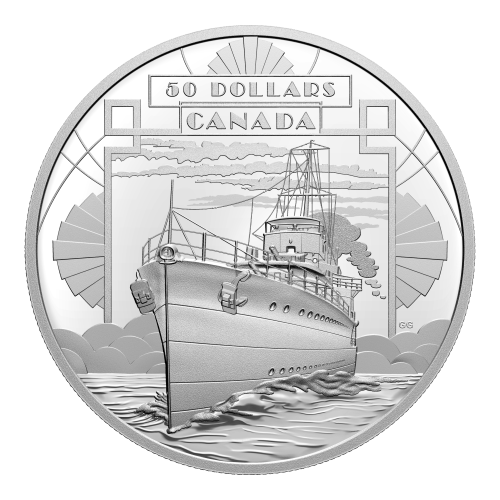
Le voyage à travers l'histoire continue ! La deuxième pièce de la série Premier siècle de la Confédération est une représentation du style art déco du Canada entre 1914 et 1945. On peut y voir l'un des premiers navires construits pour la Marine royale canadienne.
C'était une époque où le Canada, encore jeune, naviguait dans des eaux incertaines, rendues encore plus troubles par deux guerres et une dépression économique paralysante. Des vagues d'immigrants avaient débarqués sur les rives et déferlé vers l'ouest, transformant la société et enrichissant la structure culturelle. Mais les marées changeantes de l'histoire ont également porté le meilleur du Canada et les espoirs de paix dans des endroits comme Vimy, et plus tard, Juno Beach, deux tournants clés qui ont marqués la maturité du pays, représentée sur cette pièce.
Une magnifique pièce qui raconte une histoire puissante à travers un art captivant.
Caractéristiques spéciales :
- L'HISTOIRE EN MOUVEMENT ! Voici la deuxième pièce de cette passionnante série de trois qui allie art, histoire et technologie ! On peut y voir l'histoire du premier siècle du Canada (1867-1967) à travers une perspective artistique et représentée par différents moyens de transport qui ont défini leur époque.
- UN STYLE ART DÉCO ! Alors que vous observez chaque pièce, laissez le style artistique vous guider dans ce voyage à travers le temps ! La deuxième pièce présente le style moderne art déco, considéré comme le successeur de l'art nouveau (vu sur la première pièce)
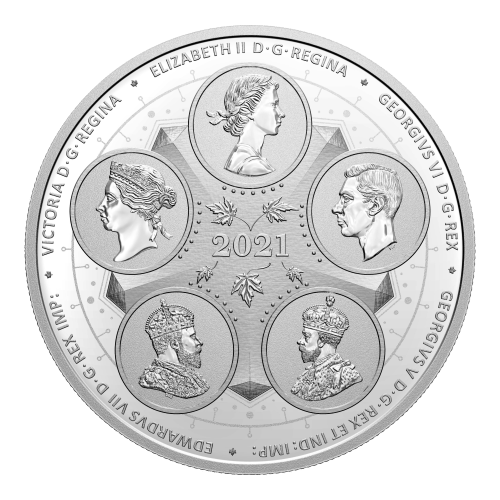
- CINQ EFFIGIES SUR UNE SEULE PIÈCE ! L'avers à effigies multiples présente les effigies de cinq monarques qui ont été chefs d'État constitutionnels du Canada entre 1867 et 1967, et dont les règnes combinés couvrent un siècle de changement. Chaque effigie est accompagnée d'une mention latine indiquant le nom et le titre royal du monarque, comme on peut le voir sur certaines des pièces les plus historiques de la Monnaie royale canadienne :
- D.G. – Dei Gratia, « Par la grâce de Dieu »
- REGINA – « Reine »
- REX – « Roi »
- IMP – « Empereur »
- IMO:IND – « Empereur de l'Inde »
- CONÇUE POUR VOUS ! Collectionneurs, cette série est pour vous ! Chaque pièce de cette série est une œuvre d'art captivante et raconte une histoire fascinante. Et les effigies contenues à l'avers ne représentent pas seulement l'histoire canadienne : elles représentent un passe-temps et un siècle d'histoire numismatique du pays. L'une de ces effigies précède même la Confédération !
- UN TRÉSOR RARE ! Soyez l'un des quelques privilégiés à posséder cette pièce d'argent pur à 99,99 %. Son tirage est limité à seulement 1250 exemplaires dans le monde.
- UN CERTIFICAT NUMÉROTÉ ! La Monnaie royale canadienne certifie l'authenticité de toutes ses pièces de collection.
Conception :
Conçu par l'artiste canadien Glen Green, le revers de la pièce représente un symbole du nouveau statut du Canada sur la scène mondiale après la Première Guerre mondiale (1914-1918). Des éléments Art déco entourent la représentation du NCSM Saguenay : construit en 1931, le navire a été l'un des premiers navires de guerre construits pour la Marine royale canadienne, avant l'expansion rapide du service naval pendant la Seconde Guerre mondiale (1939-1945). L'avers combine cinq des effigies qui figurent sur les pièces canadiennes depuis 1867 (dans le sens horaire, à partir du haut) : la première effigie de Sa Majesté, la reine Elizabeth II selon Mary Gillick, avec la mention latine « ELIZABETH II D·G·REGINA » ; l'effigie du roi George VI selon T.H. Paget, avec la mention « GEORGIVS VI D·G·REX » ; l'effigie du roi George V selon Sir E. B. Mackennal, avec la mention « GEORGIVS V D·G·REX ET IND: IMP: » ; l'effigie du roi Edward VII selon G. W. De Saulles, avec la mention « EDWARDVS VII D·G·REX IMP: » ; et l'effigie de la reine Victoria selon L.C. Wyon, avec la mention « VICTORIA D·G·REGINA ».
Le saviez-vous ?
- La Première Guerre mondiale est souvent citée comme le début d'une nouvelle ère pour le Canada. Le pays est entré en guerre en 1914, comptant une armée de seulement 3 110 hommes. Sa marine, fondée en 1910, comptait deux vieux croiseurs et 350 matelots. À la fin de la guerre, plus de 650 000 hommes et femmes du Canada et de Terre-Neuve (alors une colonie distincte) ont répondu à l'appel du devoir qui a coûté la vie à 66 000 d'entre eux. Pour un pays qui ne compte que huit million d'habitants, ce fût une importante contribution. Le Canada en ressort avec une toute nouvelle réputation internationale et une identité nationale qui s'affermit.
- À la fin de la Seconde Guerre mondiale, le Canada est devenu un membre éminent de la communauté internationale et possédait l'une des marines les plus larges au monde. Plus d'un million de Canadiens et de Terre-Neuviens ont servi lors de cette guerre, qui a coûté la vie à 45 000 d'entre eux et en a blessé 55 000.
- Le NCSM Saguenay (représenté sur cette pièce) a été déployé au début de la Seconde Guerre mondiale. Ce destroyer de classe River a été construit dans le Hampshire, au Royaume-Uni. Le navire a été mis en service dans la Marine royale canadienne à Portsmouth (R.-U.) le 22 mai 1931 et est arrivé à Halifax le 3 juillet 1931. Le Saguenay a été affecté à des tâches de convoyage tout au long de la Bataille de l'Atlantique. Il s'agit de la plus longue bataille de la Seconde Guerre mondiale, et le Canada a joué un rôle important dans cette campagne.
- L'Art déco était populaire dans l'entre-deux-guerres. Successeur de l'Art nouveau, l'Art déco est facilement reconnaissable avec son style au caractère fortement géométrique. Sa popularité a atteint son apogée dans les années 1920 et 1930, mais ce style continue d'influencer les artistes et les architectes d'aujourd'hui.
Emballage :
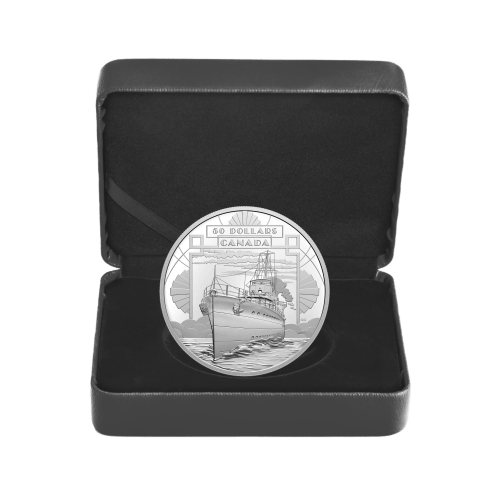
La pièce est individuellement encapsulée et présentée dans un boîtier à double coque orné du logo de la Monnaie royale canadienne, accompagné d'une boîte de présentation noire.
Passez votre commande dès aujourd'hui !
