Pièce 1 once d'argent Oiseaux colorés : Jaseur d'Amérique 2022 | Monnaie royale canadienne


Related products
Profitez d'un spectacle de couleurs contrastées de Mère Nature sur le thème des oiseaux.
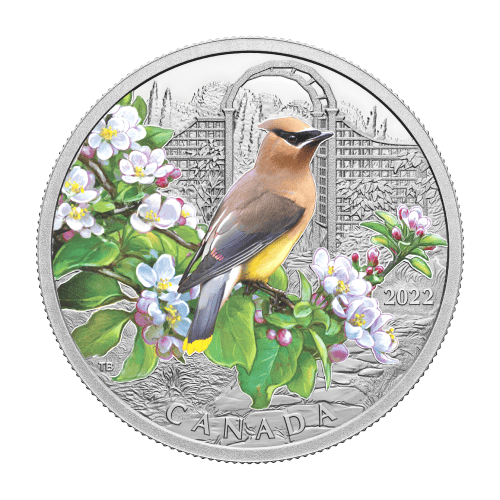
Vedette de la deuxième pièce Oiseaux colorés de la Monnaie royale canadienne, le jaseur d'Amérique a une apparence distincte grâce à sa huppe lissée en arrière, à son masque noir et à ses plumes jaunes et brunes soyeuses. Cette espèce grégaire, présente dans toutes les provinces et tous les territoires du Canada, aime se nourrir en volées. Elle raffole des insectes et des petites fruits, comme ceux du pommetier en fleur représenté sur ce motif inspiré de la nature.
Voici une magnifique pièce qui ne manquera pas d'égayer toute collection sur le thème de la nature ou des oiseaux.
CARACTÉRISTIQUES SPÉCIALES
- Deuxième pièce. Après la pièce Geai bleu en 2021, le jaseur d'Amérique devient la vedette de la deuxième pièce de la série Oiseaux colorés, frappée dans 1 once d'argent pur à 99,99 %.
- Pour les amoureux de la nature. Avec ses magnifiques couleurs, cette pièce accrocheuse est un cadeau idéal ou une addition parfaite à toute collection sur le thème du Canada, de la nature ou des oiseaux.
- Tirage limité. Seulement 7 500 exemplaires disponibles mondialement.
- Un certificat numéroté inclus. La Monnaie royale canadienne garantit l'authenticité de toutes ses pièces de collection.
- AUCUNE TPS/TVH
UNE COULEUR SÉLECTIVE
Les couleurs sélectives soulignent autant l'oiseau que la branche fleurie, transformant le motif en une célébration des combinaisons de couleurs vives de Mère Nature.
AN IMMERSIVE SCENE
La vue à hauteur de regard vous transporte dans la scène et donne l'impression d'être tout près de l'oiseau.
LE SAVIEZ-VOUS ?
- Certains jaseurs d'Amérique ont le bout de la queue orange plutôt que le jaune habituel. Cela arrive lorsqu'un jeune jaseur mange une grande quantité de baies provenant d'une espèce particulière de chèvrefeuille. Le pigment rouge du fruit altère la couleur des plumes de sa queue, qui n'ont pas atteint leur maturité.
- Regardez la pointe rouge au bout des plumes du jaseur ? Il s'agit en fait de sécrétions cireuses. Personne ne sait avec certitude quel rôle jouent ces tâches cireuses, mais certains ornithologues pensent qu'elles sont liées à la parade nuptiale.
- Trop de fruits au même endroit peut être nocif pour le jaseur d'Amérique ! Il peut s'intoxiquer en se gavant de baies et de fruits trop mûrs.
LE MOTIF & L'ARTISTE
Le motif au revers, conçu par l'artiste canadien Tony Bianco, présente une vue à hauteur de regard d'un jaseur d'Amérique (Bombycilla ccedrorum). Derrière lui, se trouve une arrière-cour gravée avec une allée en pierres amène à une arche en treillis. Au premier plan, les douces couleurs pastel du pommetier (genre Malus) en fleur complète le mélange de plumes jaunes, brunes, grises, blanches et rouges du jaseur d'Amérique. L'avers est à l'effigie de Sa Majesté la reine Elizabeth II, selon Susanna Blunt.
EMBALLAGE
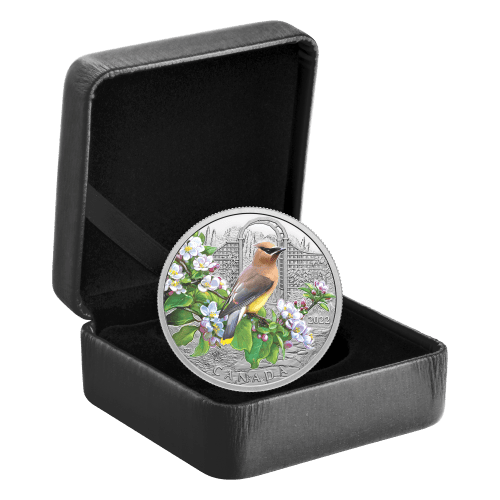
La pièce est encapsulée et présentée dans un boîtier à double coque noir portant le logo de la Monnaie royale canadienne, accompagné d'une boîte de présentation noire.
À PROPOS DE LA MONNAIE ROYALE CANADIENNE
La Monnaie royale canadienne est connue pour être l'une des monnaies les plus réputées au monde. La succursale d'Ottawa de la Monnaie royale a ouvert ses portes en 1908 et a été rebaptisée Monnaie royale canadienne en 1931 lorsque le contrôle a été transféré au gouvernement canadien. La Monnaie royale canadienne est réputée pour produire des pièces et des lingots d'or et d'argent d'une qualité et d'une pureté parmi les plus élevées au monde. Ses normes élevées en matière d'excellence et de qualité lui ont permis d'être la première raffinerie à fabriquer des pièces d'investissement en or d'une pureté de 9999 en 1982, ainsi que la première à atteindre une pureté de 99999 en 1998.
