Pièce 5 onces d'argent Perdu et retrouvé : L'astrolabe dit de Champlain | Monnaie royale canadienne
Related products
Perdu et retrouvé : Explorez le passé avec cette pièce de 5 onces ornée d'un astrolabe. Commandez-la sans tarder !
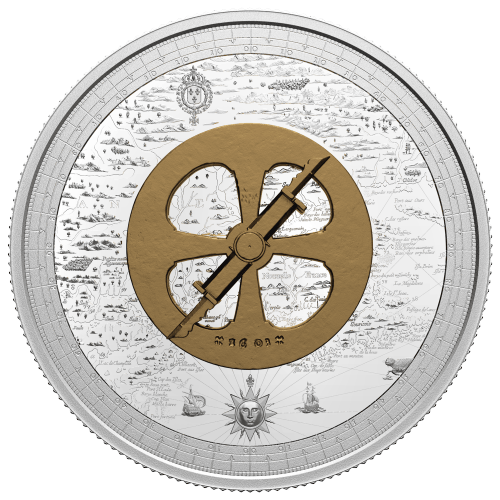
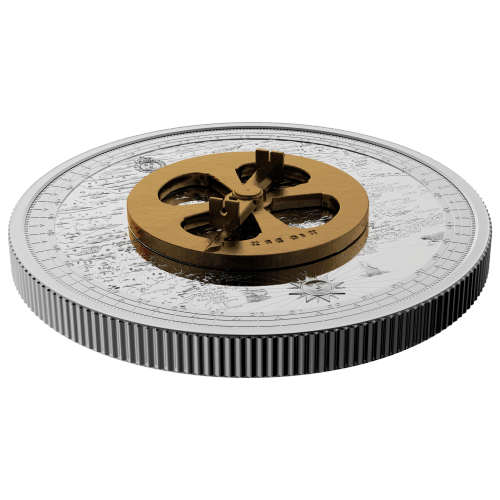
L'inspiration derrière cette pièce d'argent pur de 5 onces est l'histoire d'un astrolabe nautique du XVIIe siècle trouvé près de Cobden, en Ontario. Au revers se trouve une reproduction de l'astrolabe perdu puis retrouvé, moulée dans de l'argent et plaquée de bronze puis fixée sur une carte de la Nouvelle-France (1632) dessinée par Samuel de Champlain. Le limbe gradué de l'astrolabe entoure la carte, qui a été recréée en détail en alliant une gravure traditionnelle et une gravure au laser. Le résultat est un motif qui incarne parfaitement l'esprit de l'époque où l'astrolabe a été fabriqué, utilisé... et perdu !
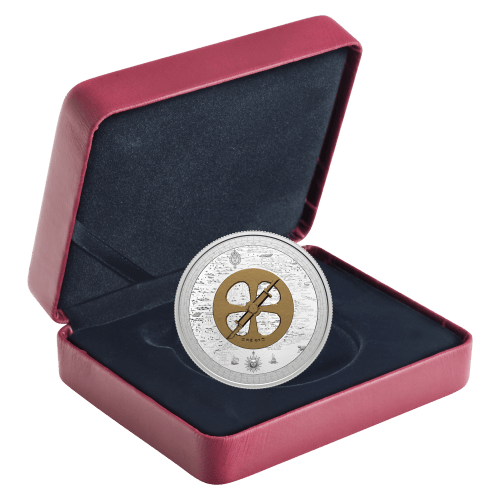
Une vitrine extraordinaire pour deux trésors historiques symbolisant notre esprit de découverte. Commandez la vôtre dès maintenant !
CARACTÉRISTIQUES SPÉCIALES
- L'ASTROLABE DE COBDEN ! Découvrez l'histoire fascinante de l'astrolabe nautique du XVIIe siècle trouvé près de Cobden, en Ontario et communément associé à l'explorateur et cartographe français Samuel de Champlain.
- MOULÉE DANS DE L'ARGENT ! Moulée dans de l'argent et plaquée de bronze, une reproduction de l'astrolabe nautique orne le revers de la pièce 5 onces d'argent pur à 99,99 %.
- DEUX TRÉSORS EN UN MOTIF ! Une reproduction gravée de la carte de la Nouvelle-France dessinée à la main par Samuel de Champlain se trouve à l'arrière de l'astrolabe nautique — un clin d’oeil à l'histoire de l'astrolabe autant qu'à l'époque qu'il représente.
- UN MÉLANGE DE TECHNIQUES ! Le limbe gradué de l'astrolabe est gravé minutieusement près de l'anneau. Les éléments de la carte ont été reproduits en alliant des techniques de gravure traditionnelle et de gravure au laser, permettant aux détails les plus infimes de ressortir.
- L'ART DE LA CARTOGRAPHIE ! Cette carte ancienne incarne parfaitement l'esprit des premières explorations européennes au Canada. Son effet saisissant en fait une pièce incontournable pour les passionnés d'histoire et de cartographie.
- FAIBLE TIRAGE ! La similaire pièce Rose des vents 2019 s'est vendue très rapidement. Cette pièce a un tirage limité à 1 000 exemplaires dans le monde.
- UN CERTIFICAT NUMÉROTÉ ! La Monnaie royale canadienne certifie l'authenticité de toutes ses pièces de collection.
- AUCUNE TPS/TVH
LE MOTIF
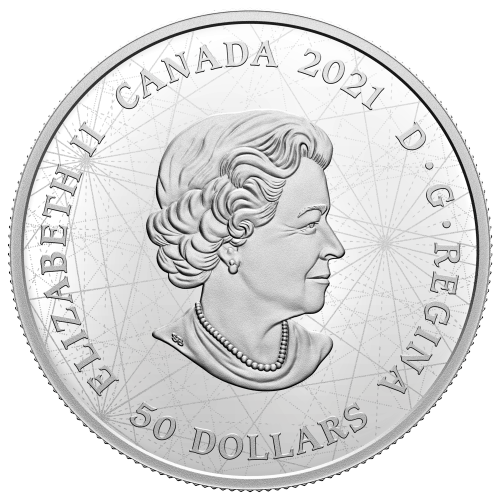
Le motif du revers contient une reproduction de l'astrolabe nautique du XVIIe siècle trouvé près de Cobden, en Ontario et communément associé à l'explorateur et cartographe français, Samuel de Champlain. Utilisé pour déterminer la latitude, l'outil de navigation devenu un véritable trésor est moulé dans de l'argent et plaqué de bronze. À l'arrière se trouve une reproduction gravée de la carte de la Nouvelle-France (1632) dessinée à la main par Champlain, entourée du limbe gradué de l'astrolabe. L'avers contient l'effigie de Sa Majesté, la reine Elizabeth II par Susanna Blunt.
LE SAVIEZ-VOUS ?
- L'astrolabe « perdu » de Champlain. L'idée émergea au XIXe siècle après la découverte de l'astrolabe, mais le compte-rendu détaillé de l’expédition de Champlain en 1613 sur la rivière Ottawa ne mentionne nul part qu'un instrument de navigation a été perdu. Cependant, l'astrolabe nautique porte la date « 1603 » et a été trouvé sur une route rarement empruntée mais que Champlain a utilisé. L'explorateur français aurait utilisé un astrolabe lors de ses nombreux voyages en mer et pour cartographier les côtes et les voies navigables de l'est du Canada. Une autre théorie veut que l'astrolabe ait appartenu à des missionnaires ou autres voyageurs ayant utilisé la même route que Champlain.
- L'astrolabe a été trouvé en août 1867. Un garçon de 14 ans aidait son père à couper des arbres sur la rive du lac Green (renommé aujourd'hui lac Astrolabe) près de Cobden, en Ontario lorsqu'il a déterré un « disque » de cuivre. L'astrolabe nautique a été vendu au capitaine d'un bateau à vapeur pour 10 $ puis il est passé de main en main avant d’atterrir dans une collection à New York. En juin 1989, le gouvernement canadien en a fait l'acquisition avant de le confier au Musée canadien des civilisations (aujourd'hui Musée canadien de l'histoire), où il est fièrement exposé.
- L'astrolabe est une pièce manquante. L'astrolabe de Cobden est le plus petit astrolabe nautique du XVIIe siècle restant. Il est en excellente condition à l'exception d'une pièce manquante : un petit anneau auquel un contrepoids était attaché afin de stabiliser l'instrument. L'anneau était encore intact sur une photographie de 1879, il a donc dû se casser à la fin du XIXe siècle.
- Un astrolabe nautique est un astrolabe simplifié. Fait de cuivre ou de bronze, il était conçu pour être utilisé en mer ; ses quatre ouvertures permettaient à l'air de passer à travers tandis que le contrepoids attaché à sa partie inférieure le stabilisait. C'était un instrument de navigation commun au XVIe et au XVIIe siècles, mais il n'en existe qu'une centaine aujourd'hui, dont le célèbre astrolabe de Cobden, mis à l'honneur sur cette pièce.
- D'une centaine d'astrolabes ayant survécu jusqu'à aujourd'hui, au moins cinq se trouvent au Canada : un astrolabe espagnol (fabriqué vers 1565-1600) trouvé à Red Bay, à Terre-Neuve-et-Labrador et conservé par Parcs Canada ; l'astrolabe de Cobden (1603) vraisemblablement fait à Honfleur, en France et représenté sur cette pièce ; deux astrolabes – l'un français (1617) et l'autre portugais (1638) – découverts à l'Île-aux-morts, à Terre-Neuve-et-Labrador et conservés dans la même province dans l'espace culturel de The Rooms, à St. John's ; et un astrolabe portugais (1632) préservé au Vieux Séminaire de Saint-Sulpice dans le Vieux-Montréal. Un autre astrolabe (1593) découvert à Cuba par une équipe canadienne de chasseurs de trésors sous-marins se trouve probablement dans une collection privée au Canada.
À PROPOS DE LA MONNAIE ROYALE CANADIENNE
La Monnaie royale canadienne est connue comme l'une des Monnaies les plus réputées au monde. La succursale d'Ottawa de la Monnaie royale a ouvert ses portes en 1908 et a été rebaptisé « La Monnaie royale canadienne » en 1931 lorsque le gouvernement canadien en a pris le contrôle. La Monnaie royale canadienne est réputée pour produire des pièces d'investissement et des lingots en or et en argent d'une qualité et d'une pureté parmi les plus élevées au monde. Ses normes élevées de qualité et d'excellence lui ont permis d'être la première raffinerie à produire des pièces d'investissement en or fin 9999 en 1982 ainsi que la première à atteindre une pureté d'or fin à 99999 en 1999.
