Pièce 2 onces en or Feuille d'érable super incuse 2022 | Monnaie royale canadienne



Related products
La révolutionnaire pièce FÉO ultra-incuse est maintenant rehaussée d'un placage d'or rose sélectif. Passez dès maintenant votre commande !
Après avoir présenté la pièce Feuille d'érable en or (FÉO) bi-incuse rehaussée d'un placage de platine en 2018, la Monnaie royale canadienne a continué avec une version plaquée d'or rose en 2019 et une autre plaquée de rhodium noir en 2020. En 2021, la MRC a apporté une nouvelle profondeur à l'art numismatique avec la première pièce Feuille d'érable en or (FÉO) ultra-incuse. Les pièces précédentes avaient une profondeur standard de 0,3 mm, mais grâce à la technologie mise au point par l'équipe Recherche et développement de la Monnaie Royale canadienne, nous avons réussi à graver le motif complexe de la pièce Feuille d'érable en or (FÉO) ultra-incuse à 1,5 mm de profondeur, ce qui représente près de 40 % de l'épaisseur de la pièce !
Pour 2022, nous avons rehaussé la révolutionnaire pièce FÉO ultra-incuse d'un placage d'or rose sélectif et d'un motif récurrent de feuilles d'érable sur chaque côté : une fusion parfaite entre la technologie moderne et le motif classique ! Passez votre commande dès aujourd’hui !
CARACTÉRISTIQUES DE LA PIÈCE
- UNE PIÈCE RÉVOLUTIONNAIRE MAINTENANT REHAUSSÉE ! La Monnaie royale canadienne a apporté une nouvelle profondeur à l'art numismatique avec la première pièce Feuille d'érable en or (FÉO) ultra-incuse, rehaussée d'un placage d'or rose sélectif et d'un motif récurrent de feuilles d'érable sur chaque côté ! Grâce à la technologie mise au point par l'équipe Recherche & Développement de la Monnaie royale canadienne, la feuille d'érable gravée au revers de la pièce présente une profondeur sans précédent de 1,5 mm.
- UN PETIT PLUS AJOUTÉ À UN CLASSIQUE ! Avec la technologie de frappe super-incuse, vous verrez la feuille d'érable FÉO sous un tout nouveau jour. La gravure est toujours aussi complexe et détaillée que sur les pièces FÉO précédentes, mais sa profondeur exceptionnelle ajoute un degré complexité supérieure à ce motif déjà célèbre.
- UNE FINITION ÉPREUVE NUMISMATIQUE INVERSE MODIFIÉE ! Le champ légèrement givré et le relief brillant garantissent que tous les regards seront attirés par la feuille d'érable ultra-incuse qui est mise en valeur par un effet miroitant.
- UN GRAND PRESTIGE, UN FAIBLE TIRAGE ! Seulement 250 exemplaires sont disponibles dans le monde.
- UN CERTIFICAT NUMÉROTÉ ! La Monnaie royale canadienne certifie l'authenticité de toutes ses pièces de collection.
LE MOTIF
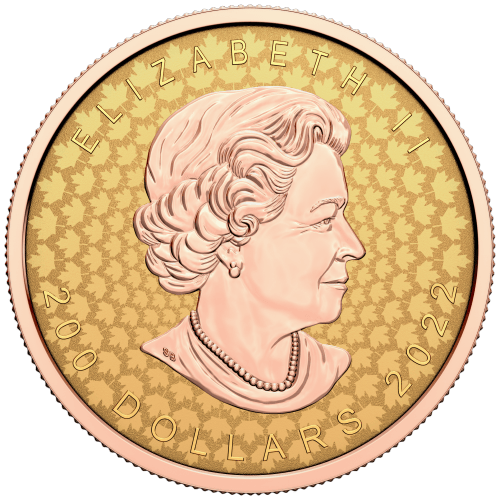
Le revers de la pièce présente le motif emblématique de la feuille d'érable à sucre conçu par Walter Ott, inchangé depuis l'émission de la première pièce d'investissement Feuille d'érable en or (FÉO) en 1979. La célèbre feuille d'érable a été frappée en utilisant une technologie ultra-incuse, permettant au motif d'atteindre une profondeur de 1,5 mm, et est rehaussée d'un placage d'or rose sélectif. Une finition épreuve numismatique inverse modifiée met en valeur le relief brillant. Le revers contient également les mentions « CANADA » et « FINE GOLD 2 OZ OR PUR », ainsi que le degré de pureté « 9999 ». L'avers présente l'effigie de Sa Majesté la reine Elizabeth II selon Susanna Blunt, ainsi que la valeur nominale gravée « 200 DOLLARS » et l'année « 2022 ».
DERRIÈRE LES PORTES FERMÉES
L'ingénieur : Yannick Cormier, ingénieur principal en recherche
Les collectionneurs doivent se demander comment nous avons réussi à créer une telle profondeur sans laisser aucune image fantôme à l'avers (par exemple, une ombre de feuille autour de l'effigie). Je dois admettre que c'était un véritable défi ! Mais l'une des clés de notre succès a été d'ajouter une étape de modelage qui a permis de préparer le matériau avant la frappe finale. En adoptant cette nouvelle approche, nous avons pu créer une impression parfaite en seulement trois frappes, bien que le creux soit beaucoup plus profond que d'habitude.
Le graveur : Ryan Poser, graveur
L'un des défi que nous avons rencontré lors de la création de cette pièce ultra-incuse a été la mise au point de l'outil prototype. Avec un motif standard, il est facile de polir le champ puisque le relief se trouve dans l'espace négatif. Dans le cas présent, nous avons dû travailler autour des éléments incus du motif, ce qui a exigé une plus grande dextérité et plus de précision. Mais avec un peu d’ingéniosité et d'huile de coude, nous avons réussi à amener ce motif iconique à un tout autre niveau !
LE SAVIEZ-VOUS ?
L'ancien graveur en chef Walter Ott (1920-2020) créa ce motif pour la première pièce d'investissement FÉO, émise en 1979. Il est, depuis, devenu le motif signature de toutes les pièces d'investissement et les éditions spéciales Feuille d'érable.
La feuille contenue sur cette pièce est une feuille d'érable à sucre, Acer saccharum. Portant bien son nom, la sève de l'érable à sucre contient la plus grande concentration du sucre, et c'est pourquoi l'érable canadien est aussi convoité par les producteurs de sirop d'érable.
EMBALLAGE
Cette pièce est encapsulée et présentée dans un boîtier à double coque marqué de la Monnaie royale canadienne, assorti d'une boîte noire protectrice.
À PROPOS DE LA MONNAIE ROYALE CANADIENNE
La Monnaie royale canadienne est connue pour être l'une des monnaies les plus réputées au monde. La succursale d'Ottawa de la Monnaie royale a ouvert ses portes en 1908 et a été rebaptisée Monnaie royale canadienne en 1931 lorsque le contrôle a été transféré au gouvernement canadien. Ses normes élevées d'excellence et de qualité lui ont permis d'être la première raffinerie à fabriquer des pièces d'investissement en or d'une pureté de 9999 en 1982, ainsi que la première à atteindre une pureté d'or de 99999 en 1998.
