Pièce 1 once d'or 99999 La ruée vers l'or du Klondike Année aléatoire (Uniquement dans une capsule) | Monnaie royale canadienne

Related products
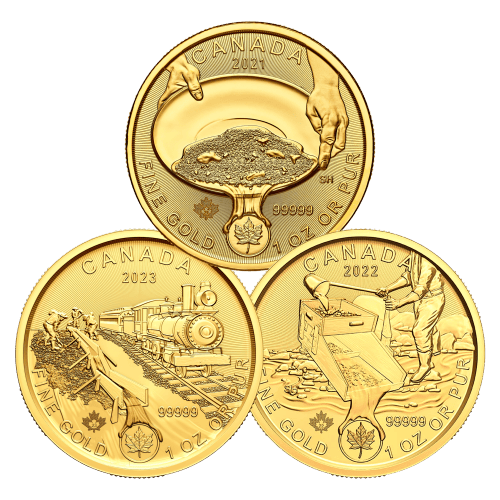
Pendant la ruée vers l'or du Klondike (1896-1899), la prospection continue et l'afflux de chercheurs d'or à destination de la ville-champignon de Dawson City ont alimenté la demande en moyens de transport. La plupart d'entre eux effectuent le périlleux voyage à pied ou en bateau, mais en 1898, les travaux de construction d'une ligne de chemin de fer à voie étroite débutent, qui servira de lien vital avec la côte et le reste du monde.
Procurez-vous une pièce 1 once d'or La ruée vers l'or Année aléatoire et devenez dès aujourd'hui le propriétaire d'un morceau d'histoire !
CARACTÉRISTIQUES DE LA PIÈCE
- Expédiée individuellement dans un emballage de protection
- Composée de 1 once d'or fin à 99999
- Avers : Présente une variété d'effigie de Sa Majesté la reine Élisabeth II
- Revers : Présente une variété de revers en rapport avec la ruée vers l'or du Klondike
La célèbre pièce La ruée vers l'or du Klondike (1896-1899) est un chapitre essentiel de l'histoire du Canada. En août 1896, Keish (Skookum Jim Mason) et son neveu Kàa Goox (Dawson Charlie) recherchent et trouvent Shaaw Tlàa (Kate Carmack) et son mari, George Carmack, avant que le groupe ne fasse la fameuse découverte qui a attiré l'attention du monde entier.
Après la découverte des premiers morceaux d'or en août 1896 à Rabbit Creek (Bonanza), la ruée initiale des prospecteurs s'est transformée en un véritable ruée l'année suivante. Cette période de prospérité a favorisé l'entrée du Yukon dans la Confédération et le développement du Canada en tant que l'un des principaux producteurs d'or au monde. Cependant, la ruée vers l'or du Klondike a également eu un impact dévastateur sur les communautés autochtones locales. Les chercheurs d'or ont déplacé ces communautés et ont mis en place des politiques qui ont fondamentalement sapé leurs modes de vie traditionnelles - un héritage avec lequel ces communautés sont toujours aux prises aujourd'hui.
À PROPOS DE LA MONNAIE ROYALE CANADIENNE
La Monnaie royale canadienne est connue pour être l'une des monnaies les plus réputées au monde. La succursale d'Ottawa de la Monnaie royale a ouvert ses portes en 1908 et a été rebaptisée Monnaie royale canadienne en 1931 lorsque son contrôle a été transféré au gouvernement canadien. La Monnaie royale canadienne est réputée pour produire des pièces d'investissement en or en argent d'une qualité et d'une pureté parmi les plus élevées au monde. Ses normes élevées d'excellence et de qualité lui ont permis d'être la première raffinerie à fabriquer des pièces d'investissement en or fin à 9999 en 1982, ainsi que la première à atteindre une pureté d'or de 99999 en 1998.
