Monnaie royale canadienne 1 once | Les pièces les plus rares du Canada Pièce d'or Point 10 centimes 1936
Related products
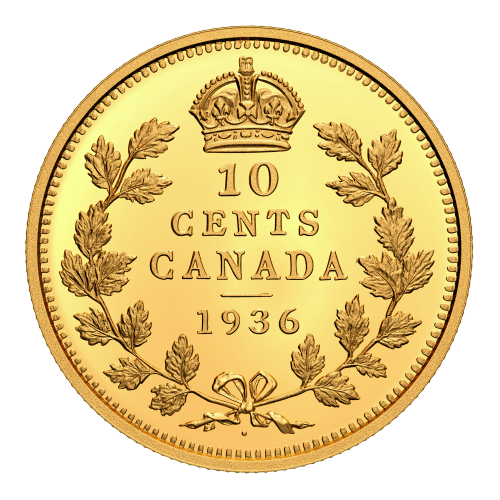
« Un minuscule point peut faire une grande différence ! C'est en fait, la caractéristique distincte d'une véritable rareté : la pièce de 10 centimes marquée d'un point de 1936. Avec seulement six exemplaires connus aujourd’hui, la pièce peu commune est le genre de trouvaille rarissime d'immense valeur qui propulse n'importe quelle collection vers les plus hauts sommets et transforme son propriétaire en véritable gardien de l'histoire. Les motifs du revers et de l'avers ont été méticuleusement répliqués dans les moindres détails, jusqu'à la date « 1936 » au revers. C'est une première pour la Monnaie royale canadienne puisque l'année d'émission a habituellement préséance.
Cette réplique en or pur est ce qui se rapproche le plus de l'original. Commandez la vôtre dès aujourd’hui !
CARACTÉRISTIQUES DE LA PIÈCE
- LA DATE D'ORIGINE ! Afin d'assurer l'exactitude historique, le revers porte la date originale (« 1939 ») au lieu de la date d'émission - une première pour la Monnaie royale canadienne !
- UN POINT D'UNE GRANDE SIGNIFICATION ! Seulement six de ces pièces de 1936 ont survécues jusqu'ici ! Frappée dans de l'or pur à 99,99 %, cette reproduction est le moyen le plus simple d'ajouter à votre collection l'un des trésors numismatiques les plus rares du Canada.
- PASSIONNÉS D'HISTOIRE ! Les graveurs de la Monnaie royale canadienne ont étudié chaque élément de la pièce originale en détail afin de répliquer son célèbre motif, de l'effigie jusqu'au nombre de denticules qui forment la bordure.
- SURDIMENSIONNÉE ! D'un diamètre de 30 mm, cette version en or put est plus large que la pièce d'origine (18,03 mm), permettant de mieux apprécier son motif très détaillé.
- UN FAIBLE TIRAGE ! Seulement 550 exemplaires de cette pièce sont disponibles dans le monde. Commandez la vôtre dès aujourd’hui !
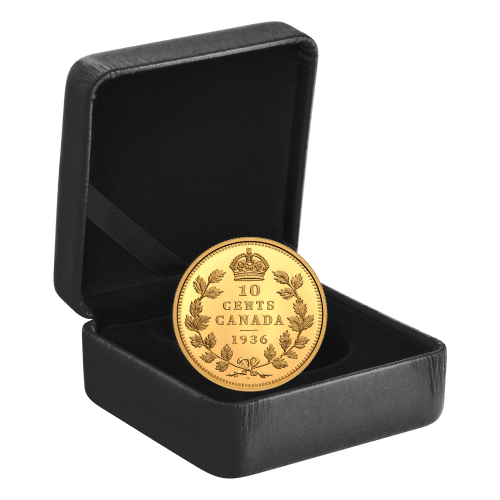
- UN CERTIFICAT NUMÉROTÉ ! La Monnaie royale canadienne certifie l'authenticité de toutes ses pièces de collection.
- AUCUNE TPS/TVH
LE MOTIF
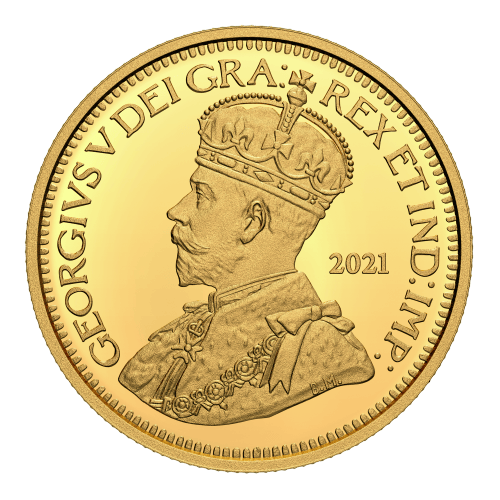
Cette pièce est une reproduction en or pur à 99,99 % de la rarissime pièce de 10 centimes de 1936 marquée d'un point. Son revers contient le motif des rameaux d'érable noués conçu par W. H. J. Blakemore et porte la date d'origine, « 1936 ». Le point placé sous la boucle est la marque distinctive des pièces produites en utilisant des motifs obsolètes au début de 1937, pendant la transition vers le règne du roi George VI. L'avers comporte l'année d'émission, « 2021 » ainsi que l'effigie historique du roi George V dessinée par Sir E. B. MacKennal.
« La pièce de 10 centimes de 1936 marquée d'un point est l'une des pièces canadiennes les plus rares qui soient. Les quelques exemplaires qui subsistent font partie des collections permanentes de musées ou de collections privées, et sont donc hors de portée pour la plupart des numismates. À l'instar des exemplaires véritables exposés au Musée de la Banque du Canada, cette pièce au tirage limité de la Monnaie royale canadienne offre une belle occasion aux collectionneurs : ils peuvent mettre la main sur une représentation spéciale d'un trésor de la monnaie du pays. » – David Bergeron, conservateur, Collection nationale de monnaies, Banque du Canada
« La reproduction d'un objet aussi rare comporte son lot de défis. Il a fallu ajouter des étapes au processus de production, mais nous étions prêts à faire le nécessaire afin d'établir un lien avec le passé et de restituer tous les détails d'origine pour les collectionneurs d'aujourd'hui. » – Melanie Luis, chef de produits
Une variante « au point » : La pièce de 10 centimes de 1936 marquée d'un point
Après le décès du roi George V le 20 janvier 1936, les préparations commencent afin de créer un nouvel avers pour 1937 à l'effigie du roi Edward VIII. Cependant la crise autour de son abdication en décembre 1936 provoque un retard imprévu et la crainte d'une pénurie de pièces conduit le pays à prendre une mesure exceptionnelle. Au début de l'année 1937, sont frappées 191,237 pièces de 10 centimes marquées d'un point surélevé au revers et portant l'effigie de l'ancien roi George V à l'avers, ainsi que la date « 1936 ». Ces pièces d'essai n'ont probablement jamais été mises en circulation et on pense que la plupart ont été fondues. Il n'y a que trois exemplaires connus à l’extérieur des collections de musée.
DID YOU KNOW
- Les pièces de 10 centimes et de 25 centimes frappées au début de 1937 comportent le point sous les rameaux d'érable croisés, tandis que la pièce de un cent contient un point sous la date. Contrairement à ces rares pièces de 10 centimes et 1 centime marquées d'un point, celle de 25 centimes a été mise en circulation. On la retrouve aujourd'hui dans de nombreuses collections privées.
- Au total, 191,237 pièces de 10 centimes marquées d'un point ont été frappées. L'un des rares exemplaires à avoir survécu est conservé dans la Collection nationale de monnaies, inclus dans un ensemble spécimen de 1937 réunissant trois pièces marquées d'un point (qui est le seul ensemble de ce genre à être toujours intact).
- Comment le point élevé a-t-il été créé ? Un poinçon a été utilisé afin d'ajouter un minuscule cercle au bord du revers.
À PROPOS DE LA MONNAIE ROYALE CANADIENNE
La Monnaie royale canadienne est connue pour être l'une des monnaies les plus réputées au monde. La succursale d'Ottawa de la Monnaie royale a ouvert ses portes en 1908 et a été rebaptisée Monnaie royale canadienne en 1931 lorsque le contrôle a été transféré au gouvernement canadien. Ses normes élevées d'excellence et de qualité lui ont permis d'être la première raffinerie à fabriquer des pièces d'investissement en or d'une pureté de 9999 en 1982, ainsi que la première à atteindre une pureté d'or de 99999 en 1998.
