1 oz 2025 Avro Arrow Proof Silver Coin | Royal Canadian Mint
Related products
Honouring one of Canada’s most fabled aircraft, the Avro Arrow.
Heralded in the 1950s as “the symbol of a new era for Canada in the air,” the Avro CF-105 Arrow was one of this nation’s greatest engineering achievements, its impressive altitude and Mach-2 speed capabilities making it one of the most advanced supersonic interceptor jets of its time. It captured the imagination of the Canadian public, and, long after the project’s cancellation in 1959, the Arrow lives on as a delta-winged symbol of Canadian ingenuity and technical achievement.
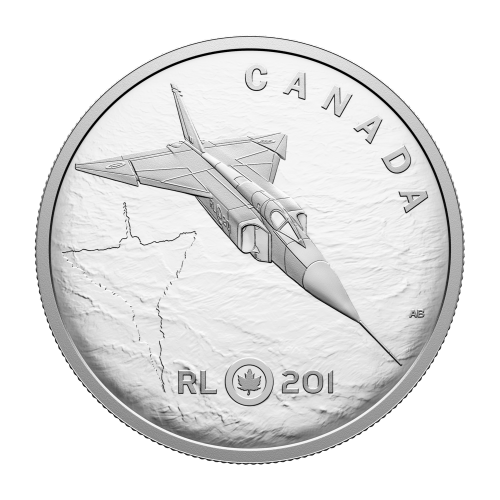
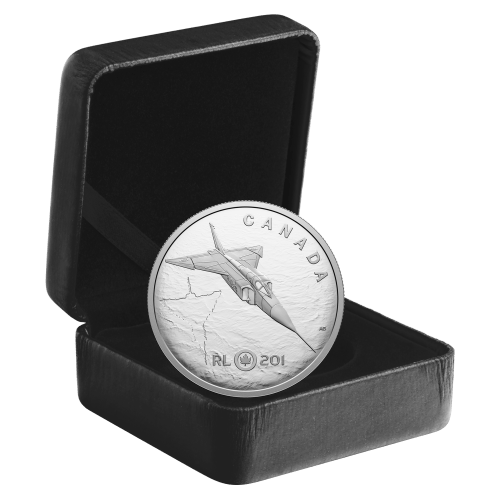
The first Arrow, RL-201, is featured on this 1 oz. fine silver coin, where the spirit of innovation that produced the storied aircraft is reflected in the waters of Lake Ontario—the very waters over which different scaled models were launched during the development phase between 1954 and 1957.
Remembering a made-in-Canada aeronautic marvel.
CARACTÉRISTIQUES DE LA PIÈCE
- The greatest plane to never serve. Celebrate an iconic piece of Canadian aviation history! One of the most advanced aircraft of its time, the Avro Arrow was cancelled in 1959, but it lives on as a Canadian symbol of advanced technical achievement.
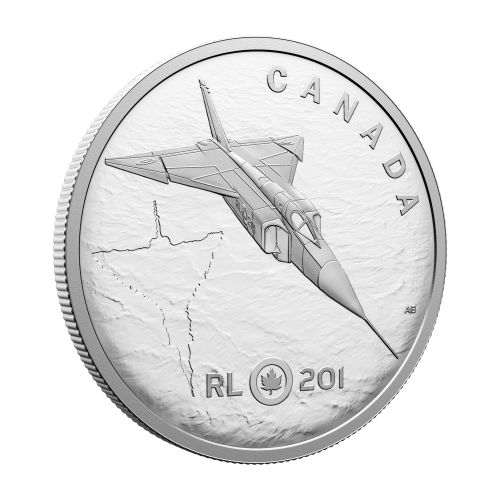
- A different view. Your coin’s reverse pays homage to the development of the Arrow, depicting RL-201 flying over Lake Ontario.
- A must-have for Arrow enthusiasts. Your coin’s design, and the story it tells, makes it the perfect gift for aircraft enthusiasts and anyone who has an interest in the history of the Avro Arrow.
- Designed by a renowned artist. Aviation artist Ardell Bourgeois is known for creating realistic works that have been featured in many museums and magazines. His designs have also graced several Canadian coins, including the 2012 proof dollar and the Second World War Battlefront: Battle of Britain coin (2015).
- Beloved theme. The Avro Arrow continues to be one of the most in-demand aviation themes, and only 10,000 coins are available to collectors worldwide, so don’t wait!
- Un certificat numéroté inclus. La Monnaie royale canadienne garantit l'authenticité de toutes ses pièces de collection.
- Aucune TPS ni TVH.
EMBALLAGE
La pièce est encapsulée et présentée dans un boîtier à double coque noir orné du logo de la Monnaie royale canadienne, assorti d’une boîte protectrice noire.
MIX OF ENGRAVING TECHNIQUES
While RL-201 was engraved using classic techniques, its outline is engraved incuse on the water, where it invokes the scale models that were launched over those very waters as part of the aircraft’s development. Bottom of Form
LE SAVIEZ-VOUS ?
This year (2025) marks the 80ᵗʰ anniversary of the founding of A.V. Roe Canada Limited. More commonly known as Avro, the aircraft manufacturer began operations in the former Victory Aircraft plant in Malton, Ont., and went on to become the third-largest corporation in Canada. It folded in 1962 after the Arrow’s cancellation.
During the development stage, the assessment of the Arrow design’s flight ability involved wind-tunnel testing and experiments using scale models. Nine small-scale models—each 1/8 the size of a fully functional jet—were launched on rockets for aerodynamic tests over Lake Ontario, eventually slipping beneath the surface.
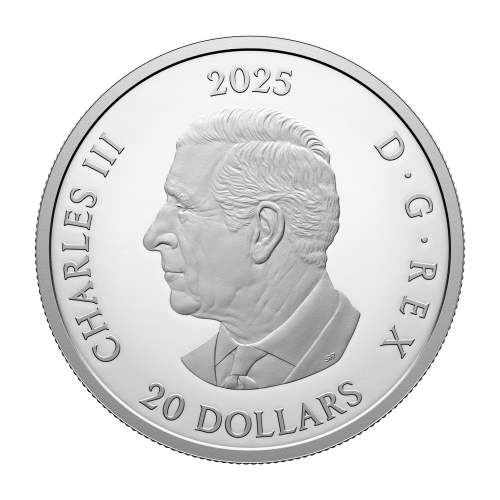
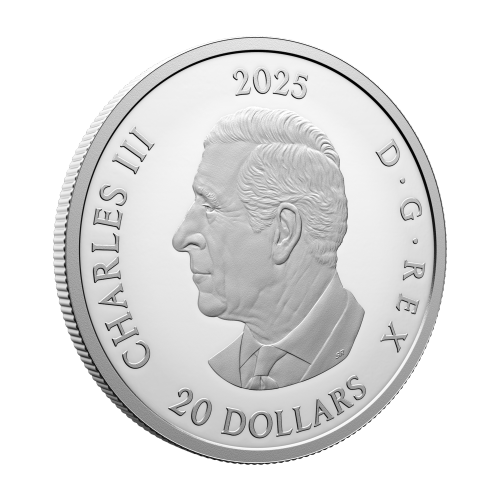
The reverse design by Canadian artist Ardell Bourgeois highlights the incredible story of the Avro CF-105 Arrow through its aerial view of the 1950s supersonic interceptor jet in flight. The view is of the first Arrow, indicated by the serial number “RL-201” (paired with the Royal Canadian Air Force classic roundel) on both the aircraft’s fuselage and in the inscription near the bottom of the design, just above the face value (“20 DOLLARS”) and year (“2025”). The image pays homage to the development of Canada’s most legendary aircraft, depicting the Arrow flying over the waters of Lake Ontario, where the small scale models were tested. This is represented by the Arrow’s outline, which is engraved incuse on the surface of the water, where it invokes the achievements that made it’s creation possible and contributed to aeronautics. The obverse features the effigy of His Majesty King Charles III by Canadian artist Steven Rosati.
FLYING HIGH: THE STORY AVRO ARROW
In 1953, A.V. Roe Canada Ltd. was commissioned to develop a supersonic interceptor that would bolster North America's air defences during the Cold War. Production began at the company's facilities in the town of Malton, Ontario, and on October 4, 1957, the first Arrow, RL-201, was unveiled to great fanfare. After a successful first flight on March 25,1958, four more prototypes were completed, plus one Arrow Mk. 2 that was 97 percent complete. The twin-engine, delta-winged Arrow was hailed as a technological triumph; it was the first production aircraft to adopt a fly-by-wire flight control system, while the newly developed Iroquois PS-13 turbojet engine would have allowed it to fly at a speed exceeding Mach 2—twice the speed of sound. But on February 20, 1959, the government cancelled the project due to mounting costs and the belief that missiles were the future threat, not manned bomber against which the Arrow was developed. All CF-105 Arrow prototypes, models, plans and equipment were to be destroyed, though some surviving artifacts can be found in Canadian museums.
À PROPOS DE LA MONNAIE ROYALE CANADIENNE
La Monnaie royale canadienne est connue pour être l'une des monnaies les plus réputées au monde. La succursale d'Ottawa de la Monnaie royale a ouvert ses portes en 1908 et a été rebaptisée Monnaie royale canadienne en 1931 lorsque le contrôle a été transféré au gouvernement canadien. Ses normes élevées d'excellence et de qualité lui ont permis d'être la première raffinerie à fabriquer des pièces d'investissement en or d'une pureté de 9999 en 1982, ainsi que la première à atteindre une pureté d'or de 99999 en 1998.
