1 oz 2025 Natures Delight: The Honey Bee Honeycomb Shaped Silver Coin | Royal Canadian Mint
Related products
Discover the buzz! Explore the beauty and significance of this hexagon-shaped coin.
Flying from flower to flower, the honey bee collects pollen, floral oils, and the nectar that is turned into honey at the hive; as it moves about, it provides an essential pollination service that helps plants grow and reproduce, ultimately contributing to one-third of the foods we eat.
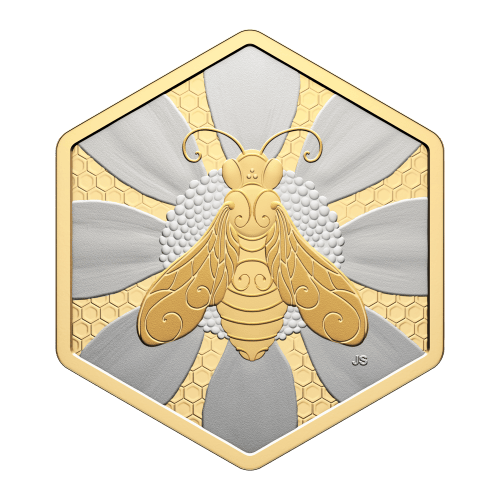
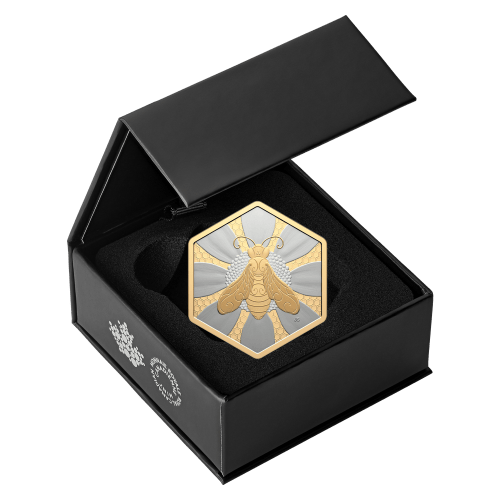
Known to be efficient both in instinct and design, the honeybee and its comb are beautifully adorned with yellow gold plating on this 99.99% pure silver coin, which, fittingly, features the popular hexagon coin shape that mimics the natural design of a honeycomb cell, widely considered to be nature’s perfect structure.
A honeycomb-shaped showcase.
COIN HIGHLIGHTS
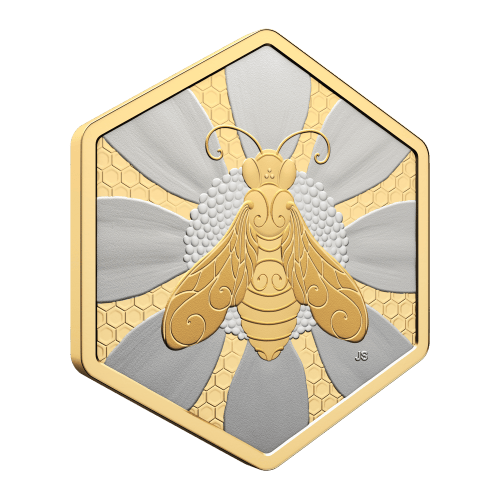
- Selective gold plating. On your coin’s reverse, the honey bee and the honeycomb background are plated with yellow gold, its amber honey hue contrasting beautifully with the silvery flower petals.
- A winged wonder. Honey bees are among the world’s top pollinators, and they are a crucial part of the biodiversity on which we all depend for our survival.
- Pure silver. Your coin is crafted in 1 oz. of 99.99% pure silver.
- Limited mintage. Just 7,500 coins are available to collectors worldwide.
- Includes serialized certificate. The Royal Canadian Mint certifies all of its collector coins.
- No GST/HST.
PACKAGING
Your coin is encapsulated and presented in a Royal Canadian Mint-branded black paperboard case.
BEE-AITIFUL DESIGN
Venerated for its industrious nature, the honey bee takes centre stage on this hexagonal coin’s reverse, where the layered design artfully connects the pollinator with its pollen source and its honeycomb.
HEXAGON COIN
The six-sided coin shape from our Snowflake series generated a lot of buzz; here, the hexagonal outline resembles the shape of a honeycomb cell, where nectar and pollen are stored inside the beehive.
DID YOU KNOW?
Honey bees have five eyes and six legs, and can fly at a speed of 24 km/h. That buzzing sound you hear when a honeybee comes near? That’s the sound of its wings beating up to 240 times per second!
Depending on the time of year, one hive can contain up to 80,000 individuals – mostly female workers/foragers, a few hundred male workers, and one queen. Making honey requires team work: it takes nectar sourced from about 2 million flowers to make just one pound of honey (a beehive can yield between 10 and 100 pounds of honey in a year), and each forager only produces about 1/12th of a teaspoon of honey in her short lifetime.
Each hexagonal honeycomb cell serves as both a storehouse and a nest for larvae, and it isn’t just the honey bee that builds nests with hexagonal cells—wasps do it, too. The shape, which has inspired architects and engineers, provides several advantages, such as excellent strength-to-weight ratio, thermal insulation, space efficiency and structural stability, while minimizing the amount of building material (beeswax) required.
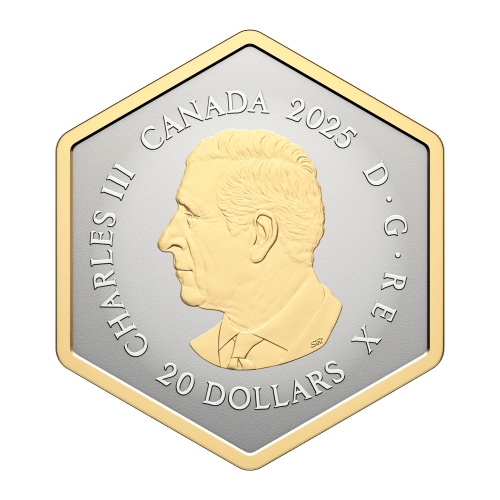
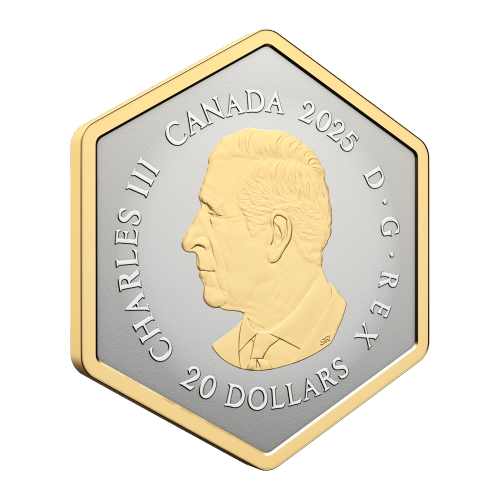
Inspired by daisies and black-eyed Susans, the centre of a stylized flower serves as a landing pad for a busy honey bee (Apis mellifera) in this reverse design by Canadian artist June Steube. The bee’s central position reflects its importance as a pollinator, while the overhead view allows for a more stylized representation of its wing pattern. The honeycomb in the background is visible between the flower petals, its hexagonal cells mirroring the coin’s six-sided shape. Both the bee and the honeycomb, as well as the rim on both sides, are plated with yellow gold. The obverse features the gold-plated effigy of His Majesty King Charles III by Canadian artist Steven Rosati.
ABOUT THE ROYAL CANADIAN MINT
The Royal Canadian Mint is known as one of the most reputable mints in the world. The Ottawa Branch of the Royal Mint opened in 1908 and was renamed The Royal Canadian Mint in 1931 when control was transferred to the Canadian government. Their high standards for excellence and quality allowed them to be the first refinery to manufacture 9999 fine gold bullion coins in 1982, as well as the first to reach 99999 fine gold purity in 1998.
